Okitsu 興津宿
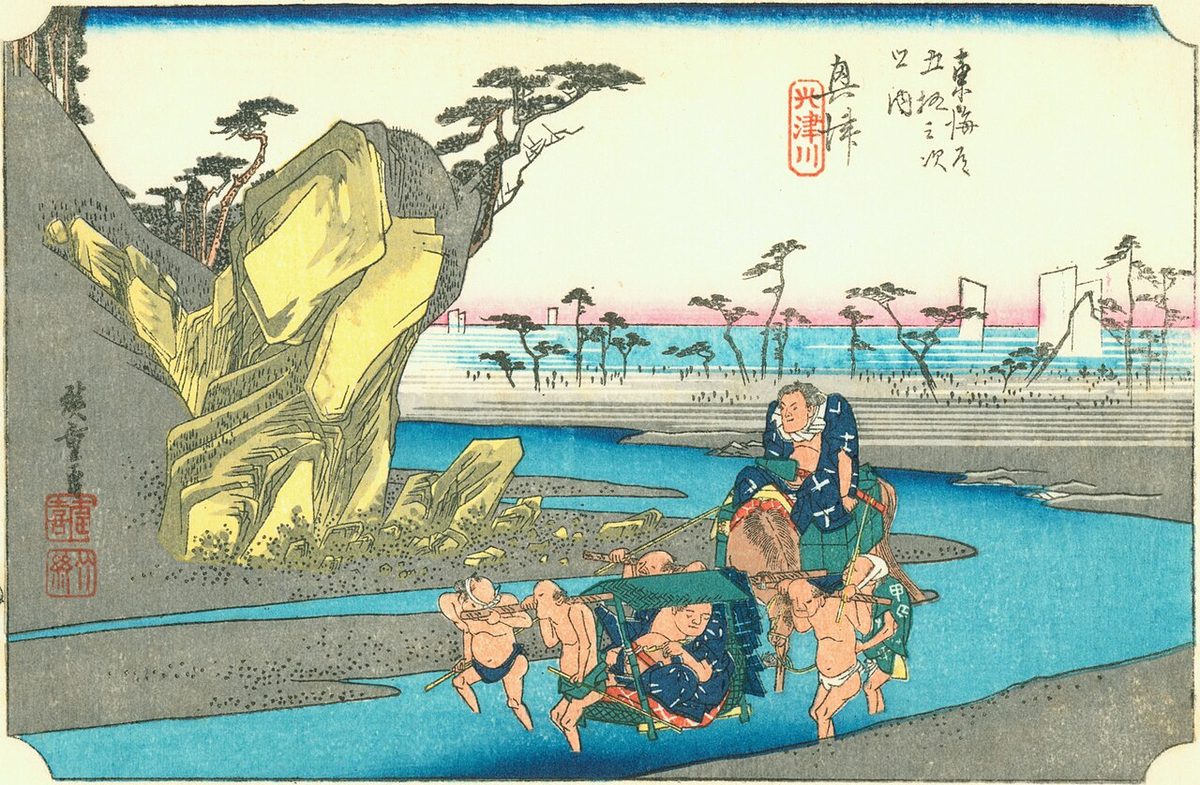
| Tōkaidō (東海道) | Station 17 of 53 · Nihonbashi (Edo) → Kyoto |
|---|---|
| Present-day location | Shimizu-ku, Shizuoka, Japan |
| Prefecture | Shizuoka (Chubu region) |
| Distance from Nihonbashi | About 161 km (by the historical station tables) |
| Next station | Ejiri-juku — about 4.1 km on |
Okitsu is a place name in Shimizu Ward, Shizuoka City, Shizuoka Prefecture. The seashore around here has been known since ancient times as Kiyomigata, and famed as a poetic place-name (utamakura). It is said that the name of the site is derived from the fact that Okitsu-Shimahime-no-Mikoto, one of the deities enshrined at Okitsu Munakata Shrine, made her dwelling in this land. There are other theories that it came from the rise of tin, the rise of fresh water ports, and the residence of Mr. Sato, who led the navy from the time of the end of peace. It is also said that the names in ancient times were called in secret. The area now called Okitsu coincides with the former town of Okitsu, which merged into the then city of Shimizu in 1961. In addition to the subject of paintings and songs, the cross-country of the Taded and Kadesh, the time of the war, the time of war is often mentioned on the history stage at the center of a clean view, at the center of the Imperial Palace, at the command of the ruling powers, in modern times, in the eye of the winds and in the rise of the winds.
History
In ancient times, it was called (in ancient times, deep breath, breath, etc.) and so on. It was known that the Shinkansen who wanted Mt. Fuji was a place of view, and anciently it was set up as a place of view and a place of breath. It is said, however, that this breath is more west-side sand than today's hot spring. Edo period became Okid, the 17th post town, and also the intersection with Kharashasha. It was said that since the name of the person and the name of the father and father often stayed in the boarding house of the state of the theater, the Oki's name used Oki to avoid trouble. In 1872, the Inn's station regime was abolished. However, the railroads were opened, and the former famed beach house, such as the Western Garden's ambitious swimming house, was built, and became known as a shelter and shelter. In 1960 (35) a fresh water pier was built as part of the expansion of the fresh water harbor, and beaches were buried in 1965. Then, in 1979, because of the open bypass, it is difficult to go directly to the sea. About 680 - in preparation for Tohoku northern China - a location was established here, and it was called a clean view. Later, a Buddhist temple was built as a protection for the authorities, and they built this Buddhist temple to tell it that it was the beginning of a temple. In the year 927 - a procrastination ceremony was held, and the station house in which the country's stations were served with ten station horses. Mr. Takashi ruled as a resident's millionaire. In 1345 - each country has its temple tower. Takashi temple is the temple of Nintendo, a rising nation. I'm going to give you an example of how to do this. In 1663 - the Ministerate's Office was put in power. The original temple is a temple-like area. In 1793, the Seo-yeon, Innji and Yaki will be ruled by the Chief of the Ministry of Kosaka. In the end, the Oikin's journey of 50rd and 50rd was followed by 38 houses, including Jonjin Wichi-Honjin. In 1868-Iseshima Hall was put up to rule. In 1872, the Grand District Act will be introduced. Fukuoka belongs to the two districts, each with its assistant director and assistant manager. In 1879, a new law of three districts will be passed. The Major District Regulation will be abolished, and the entire county will become a county hall, and Hanazawa's main building will become a temporary hall. In 1884, we built a new town hall in Toshihara. In 1889, at the same time as the opening and opening of the Tokyo Station. In 1889-City Towns Act, we will unite and define villages from Okiichi and other villages as Tokyo. In 1890-Huhara County Hall will be transferred to Ebre. In 1902, the Department of Agriculture and the Ministry of Agriculture, the Gardening and Gardening Schools, opened. In 1912, at the Department of Agriculture and the Department of Agriculture Research and Gardenry, the diplomatic cherry tree from which the cherry blossoms will be made in Washington at the request of the mayor of Tokyo. The breeds belong to Shikoku, the Riku bank, and the Taiwanese family. (In return, the hanami is designated as the flower of Suruga-ku.) The year 1914-Hungacho-City was established. In 1919 the Nintendo of Old and West Gardens will build a beach house. In 1928-Huzugawa decided to plan a water station in Shizuoka City. In 1947 - and due to local law enforcement - Yoichi is going to be a local public organization. In 1961, I am joined by Shire-Cree, Koshima, Oshima, and Both of them. In the same year, about a novel written about an Okiki-Honjing, written about a once-in-a-year project. The construction of the docks began in 1962. In 1975-Hungsu district's sequester bypass began to be used. In 1979, at the site of the river paper mill, a prefecture park was built. The settlement will begin. I'm going to go back to the 400-year history. In 2004, the floating fishing house was restored, and it was published in the name of the floating fishing house. In 2012-100th anniversary, the United States government donated a cherry tree on the Potomac River, and a tree planted in Japan was planted as a "Resister Sakura" in Tohoku Park.
It's a tourist spot
The Shinto shrine. Isegawa. A fishing house. Kunihito. I'm going to take you on a journey of 50 or 50 miles. A merchant from an elite servant of Edo period, who is well known for his trust in Takeshi Takeshi. A new school, which is a union in the end of the journey, is known. Since the Meiji era, it has been known as the high-end tourist resort for honors and political capitals to visit. He was also known abroad in his Stuttler story. At present, by the will of Mr. Half-Czero in his 20s, he's been presented to the 7th Chief member of the Suzuki Group and is protected as a museum. (The last journey from the small town of Pott) It's a travel hotel where you can eat your best toys. The lawn is also open as a hostery. It's a beautiful place near the Suuga-Kuji valley, the moon's attractions, and the singing pillow. It's called Tohoku Shizuoka. The entrance to the temple of Kunihito. I was made a subject of Japanese songs and Japanese songs, along with Mire Matsuhara. It's like this. The performance of the "Santazu" show. From ancient times, it was a beautiful place to start as a linguad, and even the warriors, the servants, and the emperor gave it their names. "Europe's smoke and the moon's shadowing of the sun's moon" "The famous orange was named because it was created on a local plating. There is a centenarian-sama spirit, and the warriors in the tea pot are dressed as gods. It is the temple of Mr. Ibukagi-san and the altar of the house of the house of Okiyon Honjin, the founder of Japan. (The rising tsunami, the rising wave, the rising waves) And when local fishermen encountered a great storm, they were forced to remember the constant value of a single beam of light shining from a stable where the waves were calm and the fisherman was able to return safely. This led to the worship of a "sun-hungry value" that protects people from sea trouble. There's a steady waterfall going down. There's a nearby shrine. There's a blind journeyer called "Sun-Sun-Sun-sun-san" and he's believed to be the god of the eye and the god of the eye and the god of the eye. There's a rice barn. There's a silver lining in the area. In the days of the religious order-in-war, there was a temple on the high ground in which it is believed that there was a temple that led the water forces before the transfer of the headquarters of Mr. Fujisawa castle.
Industrial and masterpieces
Okitsu-dai (Okitsu sea bream): it is said that Tokugawa Ieyasu — who as a boy, under the name Takechiyo, studied at Seiken-ji temple — ate sweet sea bream (amadai) there, and that after he became ruler of Japan he remembered it fondly, asked for it again, and gave it this name. Products include amadai dried overnight (ichiya-boshi), dried Okitsu fish (hoshi-Okitsu), and amadai grilled in "pinecone" style (matsukasa-yaki).
Unshū mikan (satsuma mandarins).
Kiyomi oranges.
Loquats (biwa).
Kuro-hanpen and hiryūzu: called "hiryūzu" or "hiryōzu", these are made around Yui and the Okitsu River in this area by mixing root vegetables into a distinctive rough-textured sardine fishcake paste and frying it firmly to a brown colour. The inland-type Kurasawa horse mackerel (aji) of the same area is also a noted product.
Cherry trees: the Japan–US friendship "peace diplomacy cherries" — donated at the request of the then mayor of Tokyo to the shore of the Potomac in Washington, D.C., where they became the origin of the National Cherry Blossom Festival — were produced at the Okitsu Citrus Experiment Station (formerly the Horticultural Department of the Agricultural Experiment Station of the Ministry of Agriculture and Commerce), the variety being Arakawa-zutsumi and the rootstocks gathered from Itami City, and were shipped from Yokohama Port. The flowering dogwood (hanamizuki) sent in return is the city flower of Shizuoka City. In honour of these cherries, the Okitsu-juku Kanzakura Festival is held every year in early February.
Plum: a plum tree that Ieyasu planted by grafting at Seiken-ji in his Takechiyo days is said to have flowered just as he became ruler of Japan, and is therefore called the Garyū plum (Garyū-bai). A sake has been named after it. There is also a story that at the Battle of Satta Pass (the three-sided battle), Sanada Masayuki — later famous — brought victory to Takeda Shingen's army using local sake brewed with the clear water of the Okitsu River.
Anko (sweet red-bean paste).
Shioya's "Miyasama manjū": a thin-skinned, sake-steamed small bun — the Miyasama manjū of Shioya — served as a tea sweet for members of the imperial family and on imperial visits at Seiken-ji (Seiken Kōkoku Zenji) and at the Ippekirō Mizuguchiya.
Shizuoka tea (Suruga Kiyomi): in the Kamakura period the area was a producing region of matcha.
Hanzawa and Hanzawa
Between TōkaidōYui-shuku, there is a reserve in the room of the kyogi and between. It was named from what you see when you look from the east. Also named from putting the net-sized hazunori in a safe place. Because of the terror of Tōkaidō, the battle of Tōkaidō was waged. Modern lights in Mt. Fuji and in the Bay of the river are a beautiful landscape. A storage center was an inn, and there were several other tea houses with honjin and waki-honjin. On the edge of Nishizawa, there is the Fujisawa, and it is also known that a number of Chinese inkmen have visited. The Fujisawa house has a gun displayed at the end of the curtain, as well as a story of hiding a mountain-steel boat heading for the assembly and missing it from the hidden staircase to the chief of Shinji.
Text adapted from the Japanese Wikipedia article 興津, whose full text was translated into English for this guide by its contributors, licensed CC BY-SA 4.0. Station facts cross-checked with the road station lists (Japanese Wikipedia, CC BY-SA 4.0) and Wikidata (CC0).