Home / Tōkaidō / Kakegawa-juku
Kakegawa-juku 掛川宿
| Tōkaidō (東海道) | Station 26 of 53 · Nihonbashi (Edo) → Kyoto |
|---|---|
| Present-day location | Kakegawa, Shizuoka, Japan |
| Prefecture | Shizuoka (Chubu region) |
| Distance from Nihonbashi | About 222 km (by the historical station tables) |
| Next station | Fukuroi-juku — about 9.6 km on |
| Coordinates | 34.77293° N, 138.0159° E |
Kakegawa-juku (掛川宿, Kakegawa-juku) was the twenty-sixth of the fifty-three stations of the Tōkaidō. It is located in what is now the city of Kakegawa, Shizuoka Prefecture, Japan.
History
Kakegawa-juku was originally the castle town of Kakegawa Castle. It was famous because Yamauchi Kazutoyo rebuilt the area and lived there himself.
It also served as a post station along a salt road that ran through Shinano Province between the modern-day cities of Makinohara and Hamamatsu.
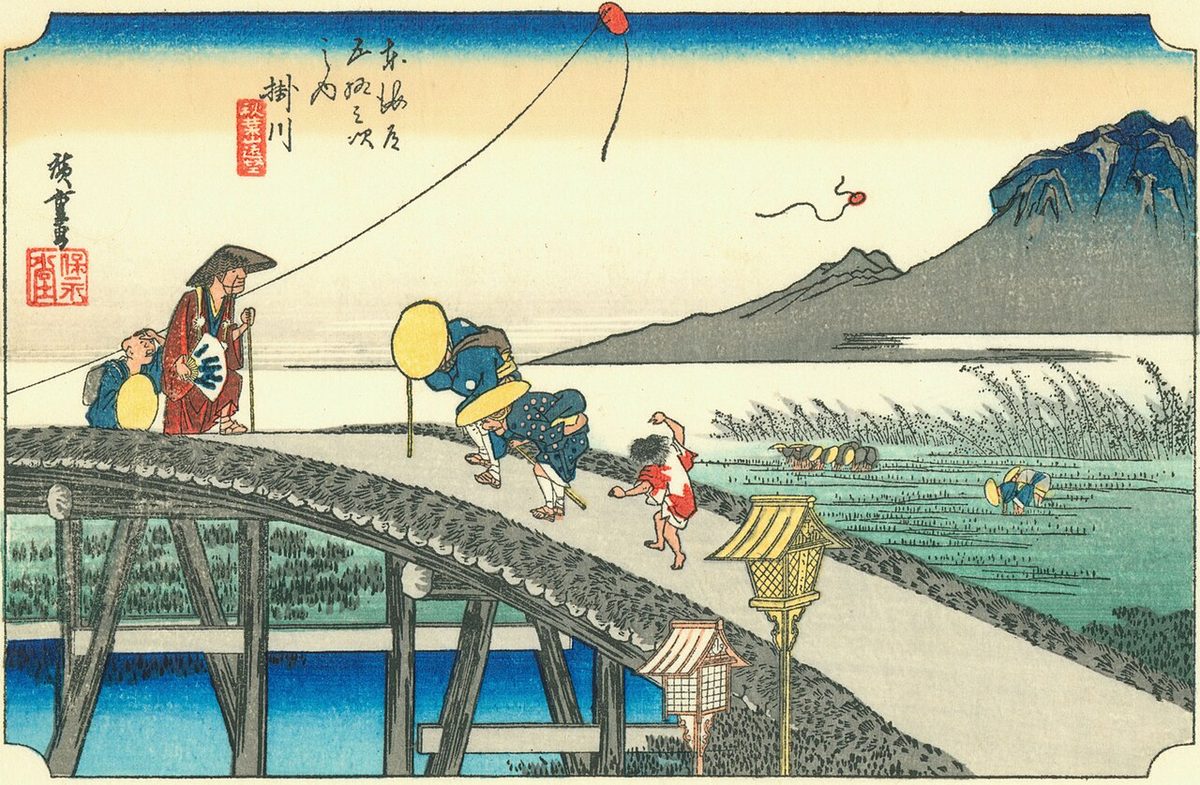
The classic ukiyo-e print by Andō Hiroshige (Hōeidō edition) from 1831–1834 depicts travelers crossing a trestle-bridge. An old couple struggles against the wind, followed by a boy making a mocking gesture. Two monks approach from the opposite end of the bridge. One of them is looking at the kite. In the background, peasants are planting rice and in the distance, Mount Akiba is shown in the mists.
Neighboring post towns
- Tōkaidō
- Nissaka-shuku - Kakegawa-juku - Fukuroi-juku
Text adapted from the English Wikipedia article Kakegawa-juku by its contributors, licensed CC BY-SA 4.0. Station facts cross-checked with the road station lists (Japanese Wikipedia, CC BY-SA 4.0) and Wikidata (CC0).